
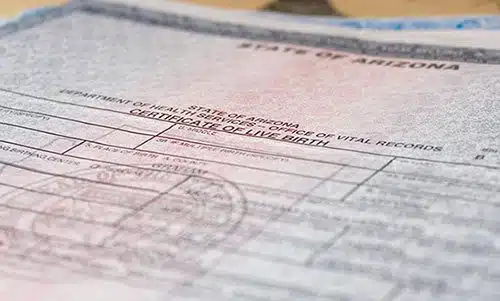
 Many people have questions about adoption birth certificates, including “What does an adoption birth certificate look like?” and “What happens to the original birth certificate after adoption?” Let’s answer these questions.
After the baby is born, the hospital birth certificate representative will present your baby’s birth mother with a birth certificate to sign in the hospital. She’ll fill out her name, the name she wants to give her baby, and the father’s name if she’d like.
As a result, your adopted child will have two birth certificates:
- the original one, which the state’s vital statistics agency will issue at birth
- the certificate issued when the courts finalize your adoption
Table of Contents
- What’s the Difference Between the Two Birth Certificates?
- What Happens to an Original Birth Certificate After Adoption?
- How Long Will It Take to Get Our Child’s New Birth Certificate?
- What About Birth Certificates for Internationally Adopted Children?
- Can an Adoptee Get Their Original Birth Certificate?
- Why Are Original Birth Certificates Sealed in Adoption?
- Checking for Mistakes on Amended Birth Certificates
- Encourage Your Child to Embrace Their Story
What’s the Difference Between the Two Birth Certificates?
Both certificates will have the most important details on them: date and time of birth, location of birth, etc. The original birth certificate lists your birth mother’s name and the name she gives her baby. She can save this one for a keepsake. The attending physician will then send a copy of the original birth certificate to the state registrar.
If you want to change the child’s name, they will do so on the new amended birth certificate, which will also list your names.
What Happens to an Original Birth Certificate After Adoption?
Once the court finalizes your adoption, the court forwards the order for adoption to the vital records department in the state where your baby was born. They will often forward another document, known as a certificate of adoption.
The vital records department in that state uses these two documents to find the original birth record of your adopted baby. Once located, the department creates an “amended” or “replacement” birth record using the adoption order.
This amended record becomes the new vital record for your adopted child. In most cases, the amended record changes the adopted child’s name. It also replaces the names of the originally listed birth parents with your names.
It may take a bit of time for you to get your child’s new amended birth certificate showing you as parents. Receiving your child’s updated birth certificate is part of the adoption finalization process.
Your child’s birth mother may offer you a copy (or original!) of this first birth certificate. It makes a lovely keepsake if you wish to include it in your child’s baby book.
How Long Will It Take to Get Our Child’s New Birth Certificate?
The timeline for receiving your newly adopted child’s amended birth certificate varies by state. Depending on where your child was born, it can take anywhere from two weeks to four months to receive the updated certificate. This difference in timing is something to keep in mind as you plan after your adoption finalizes.
It’s important to note that the adoption itself won’t be listed on the new birth certificate, but the state where your child was born will be listed. Sometimes, this is often the only indication that an adoption took place.
Today, about 90% of domestic adoptions are open adoptions, meaning there is contact between the birth mother and adoptive parents. In an open adoption, adoptive parents may have a copy of both the original birth certificate and the adoption birth certificate.
Often, there’s an open adoption agreement between the birth mother and the adoptive parents to exchange regular letters, photos, and sometimes visits. Depending upon both parties, the birth mother and adoptive parents may also agree that at a certain age, they will allow their child to connect with their birth mother directly.
What About Birth Certificates for Internationally Adopted Children?
Adopting a child in a foreign country is legally acceptable, though some state courts won’t recognize a foreign adoption decree. Therefore, experts suggest you adopt your child overseas, then re-adopt the child in the state’s court where you live.
After the re-adoption, you can request a state birth certificate. Although re-adopting your child isn’t always a requirement, it can make it easier to get a birth certificate and help offset problems for your child in the future. This step can ensure smoother processing and fewer legal complications as your child grows up and needs their birth certificate for various purposes.
Can Adoptee Get Their Original Birth Certificate?
In some states, the original certificate is sealed after the adoption and is inaccessible. If your child wants access to it once they turn 18, they can often file a petition.
It can be challenging for adoptees to access their original birth certificate after adoption, which has led to an increased push for legislative changes on birth certificate access for adoptees. We still have plenty of work to do to ensure adoptees have the same unrestricted access to their birth certificates as everyone else.
Why Are Original Birth Certificates Sealed in Adoption?
Starting in the late 1930s, states began sealing original birth certificates after adoptions to prevent public access. This practice aimed to reinforce the adoptive family by limiting outside interference, including contact from birth parents who had relinquished their rights. Additionally, sealing the original and issuing an amended birth certificate was a way to conceal evidence of an “out-of-wedlock” birth, shielding children—particularly those born to single mothers—from the social stigma of illegitimacy.
As society’s views on illegitimacy have evolved, the reason for sealing these records diminished, especially once adoptees reached adulthood. In contrast, open adoption eliminates the need for adoptees to search for their original birth certificates, as they maintain direct connections with their birth families and have access to their origins from the start.
Checking for Mistakes on Amended Birth Certificates
Several states regularly make changes to the newly amended adoption birth certificates. For example, according to research conducted by Kate Workman, Georgia, Florida, and North Carolina routinely change the place of birth to the adoptive parents’ town rather than the adopted child’s actual place of birth. Additionally, these states have been known to change the date of birth.
It’s important to carefully review the new birth certificate to ensure all information is correct. If your child’s date of birth is wrong, this could be a big problem for your child down the road, affecting everything from school enrollment to legal age verification.
If you notice mistakes or discrepancies, don’t worry, because corrections can be made. Contact the Department of Vital Records correction/amendments department at the vital records office in the state where your child was issued their amended birth certificate. They can help you make the necessary changes. Before you begin, you may need to gather identification and other required documents to make the changes. However, this process varies by state, so it’s worth calling ahead to ask what documentation you’ll need.
To sum it up, your adopted child will receive a birth certificate when they’re born. After the adoption, the original birth certificate is amended. This new birth certificate includes the adoptive parents’ names added in place of the birth parents’ names.
Encourage Your Child to Embrace Their Story
An adopted child may have lots of questions about why things happened and how their adoption relates to their identity. Be positive and supportive, always speaking positively about your child’s birth family and their decision to choose adoption. Remind your child that their birth parents’ choice was made out of love.
Growing children are always learning about who they are, what their gifts and interests are, and what makes them tick. Also, learning that part of them, and connecting it to their adoption story, encourages them to embrace it and own it. Let them share it with other people on their own time and terms if they choose to share it at all.
Your adoption process may be difficult and emotional. But no matter what, always talk about adoption as an incredibly special and positive thing. Seeing your positive behavior and attitude about it will help your child feel more confident in their story and their identity. Pessimistic comments could cause confusion or make them question their place in your family.
Want to hear more?
If you’ve ever come across the phrase “adoption certificate” in your research, you’re not alone — it’s one of the most searched adoption terms online, but there’s actually no single document by that name. In the Let’s Talk Adoption podcast episode, “The Adoption Certificate Process: What People Really Mean,” hosts Heather and Kim break down the three documents people are usually referring to — the amended birth certificate, the final decree of adoption, and original birth certificate access for adult adoptees. Give it a listen to make sense of all the paperwork!
Next Steps
After learning the answers to what happens to the original birth certificate after adoption, you probably have many more adoption questions as you embark on the path to the child God has meant for you. Our Frequently Asked Questions for adoptive parents and free adoption webinars are a great place to find more answers.
In addition, you can also speak with an experienced adoption professional by calling 727-493-0933. We are happy to help you get your adoption questions answered!
Editor’s Note: This article was originally published on January 27, 2021, and has since been updated.
Founder of Lifetime Adoption, adoptive mom, adoption expert, and Certified Open Adoption Practitioner (C.O.A.P).
Since 1986, adoption expert Mardie Caldwell has been dedicated to bringing couples and birth parents together in order to fulfill their dreams.
“Many years ago, I was also searching for a child to adopt. We didn’t know where or how to get started. Through research, determination, and a prayer, our dream of a family became reality. I started with a plan, a notebook, assistance from a caring adoption consultant and a lot of hard work; this was my family I was building. We had a few heartaches along the way, but the pain of not having children was worse!
Within weeks we had three different birth mothers choose us. We were overwhelmed and delighted. Many unsettling events would take place before our adoption would be finalized, many months later. Little did I know that God was training and aligning me for the adoption work I now do today. It is my goal to share with our families the methods and plans which succeed and do not succeed. I believe adoption should be affordable and can be a wonderful “pregnancy” for the adoptive couple.
I have also been on both sides of infertility with the loss of seven pregnancies and then conceiving by new technology, giving birth to a healthy daughter. I have experienced first-hand the emotional pain of infertility and believe my experience allows me to serve your needs better.
It is my hope that for you, the prospective parents, your desire for a child will be fulfilled soon.”



I found this post really informative and helpful. As someone who is going through the adoption process, it’s great to have a clear understanding of what the adoption birth certificate will look like. It’s comforting to know that the process is well-regulated and that there are standardized forms for adoption birth certificates. Thanks for sharing this valuable information!
Thank you for shedding light on this important topic! It’s comforting to know that even after adoption, the original birth certificate is still kept as an official record. It really highlights the balance between a child’s history and their new identity. I appreciate the clarity on how access to that information works as well!
Thank you for the feedback, Wendy!