
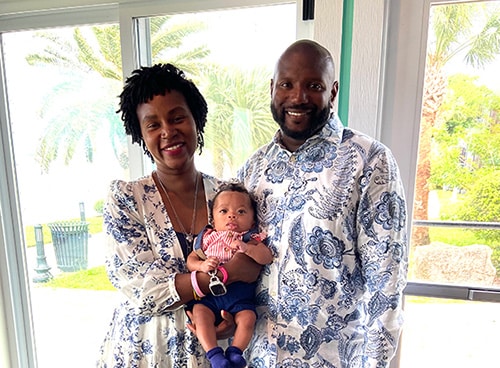
Lifetime adoptive parents Courtney and Jermel with their son
Not every family or adoptee uses this term. In this article, we’ll explain what gotcha day means, what to expect at your baby’s adoption finalization, and how families choose whether and how to celebrate.
Table of Contents
- What Does “Gotcha Day” Mean?
- How Long Does it Take to Get to “Gotcha Day”?
- Celebrating the Adoption
- Why Some Families Don’t Celebrate Gotcha Day
- Adoption Finalization Details
- Frequently Asked Questions About Gotcha Day
- How Lifetime Adoption Gets You to Gotcha Day
What Does “Gotcha Day” Mean?
The gotcha day meaning is simple at its core: it’s the day an adoption becomes legally official, marking the moment a judge finalizes the adoption and recognizes the parents as the child’s legal parents forever. Gotcha day is the informal term for the day an adoption is legally finalized in court.
The term started as informal, celebratory shorthand within the adoption community: a way for families to mark a joyful milestone, much like a birthday. Today, “gotcha day” is used interchangeably with “Adoption Day,” “Family Day,” or “Homecoming Day,” though some adoptees and adoption professionals prefer those alternatives, as they feel “gotcha” can sound a bit possessive or playful for such a significant legal and emotional milestone.
Whatever term your family chooses, the day represents the same thing: a permanent, legally protected family bond.
Gotcha day vs. placement day: Families use the term in two ways. Some refer to the day the adoption is legally finalized. Others mean the day the baby first came home, which might be months earlier. If you are planning a celebration, it helps to decide which day your family will mark and what you will call it.
Where the term came from: The exact origin is not clear, and “gotcha day” is also widely used for pets adopted from shelters. Within the adoption community, families have used it for years as a way to mark a joyful milestone. In recent years, more adoptees and adoption professionals have questioned whether the word fits such an important day. We discuss that below.

How Long Does it Take to Get to “Gotcha Day”?
Many hopeful adoptive parents wonder, “How long does it take for everything to be fully complete?” Each adoption timeline is different. Every state and local court has different adoption laws that can significantly adjust the timing. Generally, however, most adoption finalization court hearings happen within six months. But in some cases, it can take up to a year or more for domestic adoptions to run their course from the time a baby is placed for adoption until the adoptive family gets the birth certificate.
There are a variety of post-placement requirements that the adoptive couple must meet in order for things to be legally complete. As always, these vary by state. Requirements may include multiple post-placement visits as well as reports on the progress of the adopted child.
Our team at Lifetime Adoption helps adoptive parents learn about this process and secure qualified adoption attorneys and home study providers who coordinate together to see an adoption to completion.
We understand that it can be overwhelming and a bit confusing at times; that’s why we help keep the lines of communication open.
Celebrating the Adoption
Once the judge officially finalizes the adoption, many families choose to celebrate! What that celebration looks like is up to the family. Pictures of the special day and even a party to commemorate the occasion are great ideas! The party could include a mix of family and friends, and many families choose to invite the birth mother, too.
If the birth mother has indicated that she wants to stay in touch with the adoptive family and her child, keeping in contact with her is usually more than welcome.
Don’t hesitate to ask our team at Lifetime Adoption for advice on this. Because we work closely with the birth mothers and adoptive families on an individual basis, we understand that each case is unique and that different circumstances surround each one.
Why Some Families Don’t Celebrate Gotcha Day
Not every family celebrates gotcha day, and that’s a valid choice. For a child, the day of finalization or placement can be both joyful and bittersweet. It’s the day their family grew, but also the day they were separated from their birth mother. Many adoptees are grateful for their families and still feel mixed emotions about that date. A celebration focused only on the parents’ excitement might overlook the child’s feelings.
MaryAnne, a Lifetime adoptive mom and former teacher, shares why her family chose a different approach. She once asked an adopted student if they celebrated gotcha day, and the answer was no. That conversation stayed with her. Her family still talks with their daughter about the day she came home and the day the court made the adoption official, but they focus on her story instead of their own excitement. Watch her explain:

Why one adoptive mom doesn't celebrate gotcha day
MaryAnne shares how her family honors their daughter's story.
Read the transcript: Why MaryAnne doesn’t celebrate gotcha day
MaryAnne, adoptive mom and former teacher:
Gotcha day tends to be for the parents. You’re so excited you’re parents, and so of course you want to celebrate when you became a family. You want to celebrate the day they came home. But you’re also celebrating a day when the child was separated from their birth mom, whether the ties were legally severed or they were just placed with you.
As they get older, they might not see it as a celebration. They might feel a little bit of sadness about it. They might think, “I appreciate the life I was given, and I appreciate how I was raised, but this is still a different day for me.”
I used to be a teacher, and I had a student who was adopted. I asked, “Do you do a gotcha day?” And they didn’t.
I think it’s important for her story that we talk about it: “Hey, you came home this day,” or “This is the day we went to court and everything was legalized.” But we try to keep everything focused around her, and not say, “We’re so excited, so we’re going to make this day about us.” So yeah, we just don’t do gotcha day.
- Let your child lead. Their feelings about the day may change as they grow, so check in with them over the years.
- Choose your words carefully. Adoption Day, Family Day, or Homecoming Day may feel more comfortable than “gotcha.”
- Focus on your child’s story. Share the story of the day as part of their life history, not just as a celebration for the parents.
- Honor the birth family. If you have an open adoption, think about whether and how to include your child’s birth mother.
- Celebrate adoption more broadly. National Adoption Day, which takes place the Saturday before Thanksgiving (November 21 in 2026), is a family-friendly alternative.
Teachers and parents can help children feel comfortable talking about their adoption at school. See our tips for creating an adoption-friendly classroom.

Adoption Finalization Details
Many adoption finalizations take place via Zoom conferencing or by phone. In some cases, a finalization can happen without the family present, as the court often finalizes the adoption in the state where the baby was born rather than the state where the adoptive family resides. Some states process adoptions quietly, and in other cases, judges excitedly welcome those in the courtroom to witness this special adoption finalization day.
Every state and every county are different regarding the finalization process and the celebratory aspects of this blessed day. In fact, some families don’t know the court has finalized the adoption until they receive something in the mail!
In November, courts often celebrate more with open finalizations as it is National Adoption Awareness Month. On a personal level, however, some adoptive families celebrate the finalization what they call “Homecoming Day,” “Family Day,” “Gotcha Day,” “Happy Adoption Day,” or “Adoption Day.”
Frequently Asked Questions About Gotcha Day
What is the meaning of gotcha day?
Gotcha day meaning refers to the day an adoption is legally finalized in court, officially making the adoptive parents the child’s permanent legal parents. It’s also called Adoption Day, Family Day, or Homecoming Day. The gotcha day meaning centers on permanence: it marks the moment a child’s adoption becomes legally official and irreversible.
Is “gotcha day” the same as Adoption Day?
Yes. “Gotcha day” is an informal nickname for adoption finalization day, also known as Adoption Day, Family Day, or Homecoming Day, depending on the family’s preference.
How long does it take to reach gotcha day?
Most adoption finalization hearings happen within six months of placement, though it can take up to a year or more depending on the state and post-placement requirements.
Do you have to be in court for gotcha day?
Not always. Many finalizations happen by Zoom or phone, and the court that finalizes the adoption is often in the state where the baby was born, not where the family lives.
Why do some people avoid the term “gotcha day”?
Some adoptees and adoption professionals feel that “gotcha” sounds too possessive or playful for such an important day. Others note that the date also marks a child’s separation from their birth mother, which can bring mixed emotions as they grow. Many families use Adoption Day, Family Day, or Homecoming Day instead, or choose not to mark the day at all. Watch MaryAnne explain her family’s choice in the video above.
Is gotcha day offensive?
It depends on who you ask. Some families love the term, and some adoptees find it uncomfortable. If you’re unsure, ask your child as they grow, or choose a term like Adoption Day or Family Day.
Should you celebrate gotcha day?
There’s no single right answer. Some families celebrate with a dinner, photos, or a family tradition. Others skip it or celebrate National Adoption Day instead. The best choice keeps your child’s feelings at the center.
What’s the difference between gotcha day and adoption day?
They often mean the same thing: the day the adoption is legally finalized. “Gotcha day” is more informal, and some families use it for the day the baby came home instead.
How Lifetime Adoption Gets You to Gotcha Day
What does it take to adopt a baby? We understand that you probably have many different questions that need to be answered and clarified before you step into the journey of finding the child that God has meant for you.
Everything you share with Lifetime Adoption remains confidential. We will help you create an adoption plan that is unique to your situation.
No matter if you’re an expectant mom looking for answers or a couple looking to welcome a child into your home — we look forward to serving you and helping you with your happy adoption day!
Editor’s Note: This article was originally published on March 3, 2021, and has since been updated.
Founder of Lifetime Adoption, adoptive mom, adoption expert, and Certified Open Adoption Practitioner (C.O.A.P).
Since 1986, adoption expert Mardie Caldwell has been dedicated to bringing couples and birth parents together in order to fulfill their dreams.
“Many years ago, I was also searching for a child to adopt. We didn’t know where or how to get started. Through research, determination, and a prayer, our dream of a family became reality. I started with a plan, a notebook, assistance from a caring adoption consultant and a lot of hard work; this was my family I was building. We had a few heartaches along the way, but the pain of not having children was worse!
Within weeks we had three different birth mothers choose us. We were overwhelmed and delighted. Many unsettling events would take place before our adoption would be finalized, many months later. Little did I know that God was training and aligning me for the adoption work I now do today. It is my goal to share with our families the methods and plans which succeed and do not succeed. I believe adoption should be affordable and can be a wonderful “pregnancy” for the adoptive couple.
I have also been on both sides of infertility with the loss of seven pregnancies and then conceiving by new technology, giving birth to a healthy daughter. I have experienced first-hand the emotional pain of infertility and believe my experience allows me to serve your needs better.
It is my hope that for you, the prospective parents, your desire for a child will be fulfilled soon.”



0 Comments